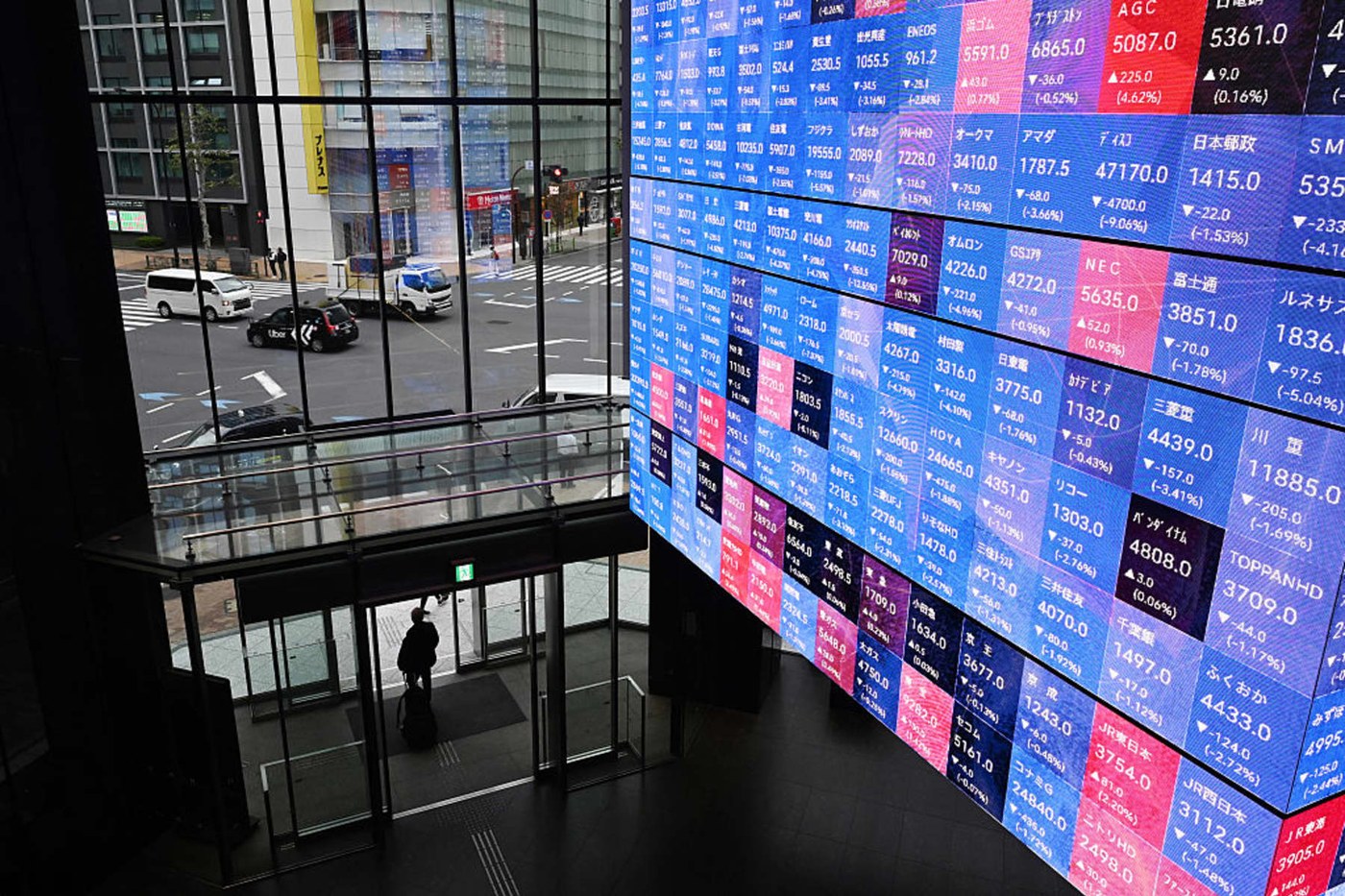
Japanese markets reacted in a seemingly counterintuitive fashion on Friday after the country's central bank hiked benchmark interest rates to their highest in 31 years.
Interest-rate increases ordinarily support a country's currency, push up its bond yields, and put pressure on its stock market. Japan's currency, bond yields, and stock market did exactly the opposite.
The yen weakened past 157 against the dollar, the yield on the 10-year Japanese Government Bond slipped, while the Nikkei 225 gained 1.5% as the BOJ raised its policy rate to 1.25%.
The hike brought the policy rate to its highest level since 1995, and came just three months after its previous increase.
Experts pointed to the split decision by the BOJ's board, as the reason for the uncharacteristic market reaction, as it indicated that the bank might not take a too hawkish stance.
"The two dissenting votes in favor of keeping rates unchanged came as a surprise," said Hirofumi Suzuki, chief FX strategist at Japanese bank Sumitomo Mitsui Banking Corporation.
The decision to hike was split 7-2, with board members Toichiro Asada and Ayano Sato dissenting from the verdict.
Asada noted that as the core inflation rate was below 2%, the economic situation might not be strong, and advocated for holding rates steady. Core inflation for August in Japan stood at 1.7%, down from 1.8% in July.
Sato also said current economic and price developments did not appear to have substantially accelerated compared to before.
The reaction of the market also stems from the fact that this hike also took place without an updated outlook report, which limited the BOJ's ability to reinforce a hawkish message through revised forecasts, according to Masahiko Loo, senior fixed income strategist at State Street Investment Management.
His view was also echoed by Shigeto Nagai, head of Japan economics at Oxford Economics. Nagai told CNBC's "Access Middle East" that the two dissenters signaled that Prime Minister Sanae Takaichi was not convinced to accede to the U.S.' request for faster and more rate hikes.
Reuters reported Friday that U.S. Treasury Secretary Scott Bessent had stressed on the need for higher BOJ rates in his meeting with Japanese Finance Minister Satsuki Katayama in May.
"Secondly, if we look at the statement, all the phrases and the tone was almost similar to what we saw in the quarterly outlook report published in July, so the tone was less hawkish than financial markets had hoped for," he added.
Higher rates — by how much?
Experts believe that another hike, likely in December, is on the table.
State Street's Loo said he expects BOJ Governor Kazuo Ueda to emphasize that every forthcoming meeting remains "live."
"The debate is no longer whether the BOJ hikes, but how far rates ultimately go," he added.
The BOJ said it would continue raising rates as economic and price conditions develop. But it also acknowledged that growth was likely to decelerate due to high oil prices stemming from the Middle East conflict.
Sam Jochim, economist at EFG International, said rates could rise roughly once every three months as underlying inflation approaches 2%. He expects a terminal rate — expected peak level — between 1.75% and 2% in 2027.
The BOJ has not forecast a terminal rate, instead it has maintained that the bank will conduct monetary policy "as appropriate" to stabilize underlying inflation at around its 2% target.
Stefan Angrick, head of Asia-Pacific economics at Moody's Analytics, expects another increase around the turn of the year, but said weak demand-driven inflation and disappointing real-wage growth would limit subsequent moves.